Oncology is a product that aims the precision medicine for cancer treatment, included Cancer Registry which has 2 hospitals in use, and Care Management in progress. Foundation is to collect cancer patients' data by providing the cancer registry tool and cancer HIS to build standardized data. To have an end-to-end patient journey, there's a care management and patient app. With these data, Oncology can provide better patient care and effectiveness.
Cancer Registry is a system for the storage and management of data of patients with cancer. The goal of Cancer Registry is to provide a convenient tool that hospitals can collect patients' information easily and decrease the error rate. Furthermore, these data can provide a good foundation for better cancer treatment.
Cancer registrars capture a complete summary of patient history, diagnosis, treatment, and status for every cancer patient. Collect the essential data and translate it into codes to the database for research and treatment purposes. Via interviews, we realized the workflow of cancer registrars, they need to know patient's conditions and treatment by reading health records, they would write down the essential information, then insert the corresponding code into the system. It's an inconvenient process and causes error easily, the tool they used doesn't have a convenient way for cancer registrars to switch between records and the tool simultaneously.

The goal of Cancer Registry is to provide an easy and error-free solution. With NLP (Natural Language Processing) process, AI previews the health record and provides the registry code suggestion to corresponding items.
1st version
In the first version, the main page is composed of the patient timeline and the cancer registry items list, cancer registrar can view the patent's treatment journey, and click the record on the journey or on the item list to preview the record. User can mark keyword and assign to a cancer registry item while the item suggestion is wrong or not supported, furthermore, to improve the AI model, cancer registrar just need to go through the items to confirm. But the result of user testing isn't great, this version is ideal for a later iteration of Cancer Registry but not for 1st version. The summarized content is too early for the user, before they fully trust this product, and the mark keyword feature was meant to be helping them while the item is wrong, but user always try to assign a keyword to each item because they thought it's necessary. Instead of speeding up the process, the 1st version cost them much more time to finish 1 patient.
2nd version
To remove the ca between cancer registrars' current workflow and this product, there's no need to add summarized content at this stage, the primary goal is to help them switch between health records and cancer registry items. Therefore, changed the main page to 2 main sections, health record, and cancer registry items, the items already insert the corresponding code so users just need to check if it's correct. And change the AI modal training mechanism, remove the mark keyword feature to avoid gaining their workload. The user testing result turned out great, and the current usage is growing stably.


From the experience of other product we learned that user research and testing is crucial, some products didn’t buy it these results, and it failed real soon. So at 1st version we did a design pivot once we found out the testing result is bad. And because of the design turned features into widget, so we can re-layout easily and made the new update within 1 week and finished user testing with a great result.
By conducting the interview, the workflow of cancer registrar and the goal setting is clear at the early stage of this product. Each member of Cancer Registry has a sharp vision about what we are solving and works closely with the TA by setting up routine checkups, we can fix the issues users occur rapidly. With this agile pace and test run with a few users, we set up a solid solution that reduced the error rate by 13.6% and can be scaled up to more hospitals once all cancer registry items are supported.
What we did at the beginning of this product is the flow is too far from our users used to do. One solution at a time, give user time to adopt. The first version is ideal if the AI model is trained well and the user might have to use this product for a period of time. Then it is time for the ideal version, that could really help them summarize patient journey efficiently.
The AI feature of the product can easily overpower any other features when presented to the TA, and they might think this is an essential step that needs to add to their workflow. Instead of speeding up and easing their workload, it causes more issues and cognition problems. The AI in this product should be added seamlessly without users knowing they are providing input to the AI model. Although we've made the iteration to solve this issue, user still needs to be taught how the AI model works. We presented the product to the hospital with AI model sharing to new hospitals the result came out great, with the IT of hospital's assistance, these cancer registrars use the product without too much concern about improving the AI model.
With tools like Cancer Registry, Oncology has built a foundation of the cancer patient database. To build an end-to-end patient journey need Care Management collect the other data. Care Management is for care providers to manage the cancer patient while treatment, and the patient can contact the care provider via instant message, phone, or the app of the hospital before the next visit. So care provider can give real-time support to the patient and the doctor would adjust the treatment based on these side effects.
High-quality clinical care requires patients to provide information regarding how they are feeling, their symptoms, and any effects of prescribed treatment. So, Patient-Reported Outcomes (PROs) are essential for care management. The most common symptom of cancer patient is pain, after they leave the healthcare facility, the care manager needs to contact them for checkups and update the patient's condition. But this is the only 1-way connection, care managers don't have an effective method to manage patients’ content and receive their condition unless they contact the care manager actively. Their solution to these problems is to document findings when each contact happens, and all the medical records are scattered in HIS since it’s not the tool crate for them.
The 1st phase is to build an efficient management tool for care manager, they currently use an online document tool to take notes of patients' most recent conditions, but the current solution can't help them organize the patient's records effectively. The goal is to build a bridge between patient and care manager, to solve their issue by providing a management tool for care manager, and effective communication for patients.
Care manager
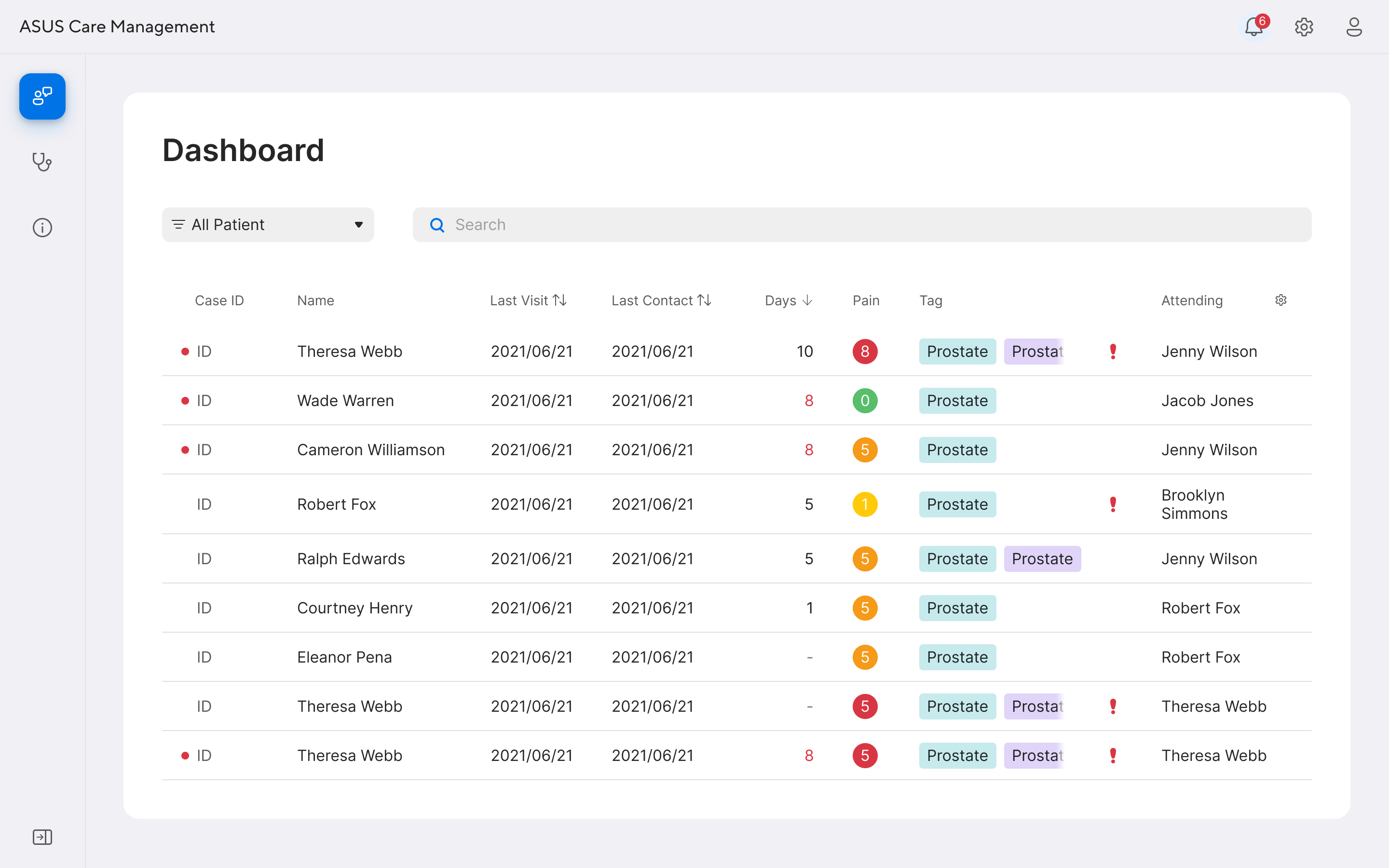
The essential information for care manager is pain level and symptoms. Based on this information, care manager can have a better understanding of patients' conditions and level of urgency before contacting them. The patient list provides the filter to easily view the patient has urgent conditions and needs routine follow-up. Before contacting the patient care manager need to understand the condition of the patient, there are basic information and a schedule for the patient. The note feature on the side can help the care manager get to know the patient's condition easily. We've tested this solution with the user and received positive feedbacks.

Patient
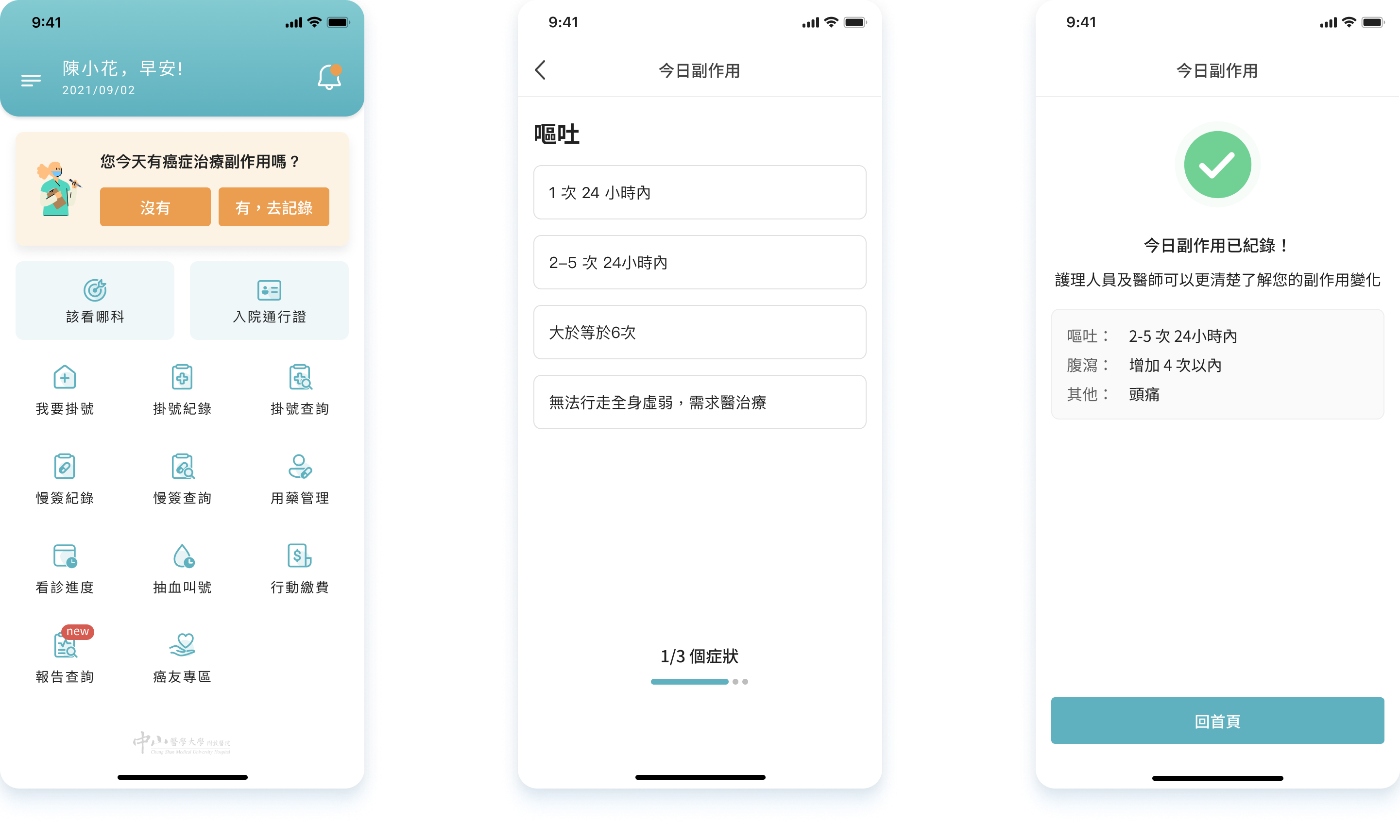
This patient app launched at 2 hospitals and 30k patients use this product. To complete the oncology product line, the patient data besides visit time is valuable. For the patient, they needs to know if there's something that needs to concern about the symptoms they have and let the care provider be aware of any condition they've occurred to make the treatment more effective and ease the discomfort. Most patient contact the care manager via phone there's no other convenient methods for them. Building an instant message in hospital's app, patients can contact the care manager easily, some FAQs can be solved by a chatbot, the patients' problem can be solved instantly, leave the difficult situation to the care manager for more comprehensive solution. The patient can also fill in the side effect questionnaires which will push notifications to cancer patient everyday to follow up their condition before next visit. Doctor can adjust the treatment based on these data. By collecting patient-reported conditions to have essential information for patient-centered care and the care manager will have more time for each patient. Once the data is ready for training, the AI can suggest effective treatments for cancer patients.

Contact me via this form